Independence Gold Project - Nevada
Project Overview
The Independence Project consists of 80 unpatented mining claims and 84 unpatented mill sites, situated in Lander County, Nevada, and spans approximately 1,861 acres of Bureau of Land Management (BLM) administered lands. The project is situated at the intersection of the prolific Eureka Trend and the Rabbit Creek Trend.
Nevada is widely regarded as one of the premier mining jurisdictions in the world, known for its rich mineral resources and supportive regulatory environment. Nevada is a leading producer of gold and consistently ranks within the top Fraser Institute best mining jurisdictions due to its stable regulatory framework, skilled workforce, pro-mining policies, proximity to markets and well-developed infrastructure.

Figure 1: Independence Gold Project in relation to major infrastructure, mining operations and significant Gold Trends in Nevada.
The Independence Project is owned by Independence Mining LLC (“IML”), an incorporated joint venture between Battle Mountain Resources Pty Ltd (“BMR”) (51.54%, the “BMR Interest”) and Americas Gold Exploration Inc (“AGEI”) (48.46%, the “AGEI Interest”).
The Project is directly adjacent to the 240koz per annum Phoenix Mine Complex, operated by Nevada Gold Mines, and about 16km south of Battle Mountain. In addition, the Project encompasses 470 acres of private fee surface land (Section 17) where the Company holds exclusive water rights for future production water wells.
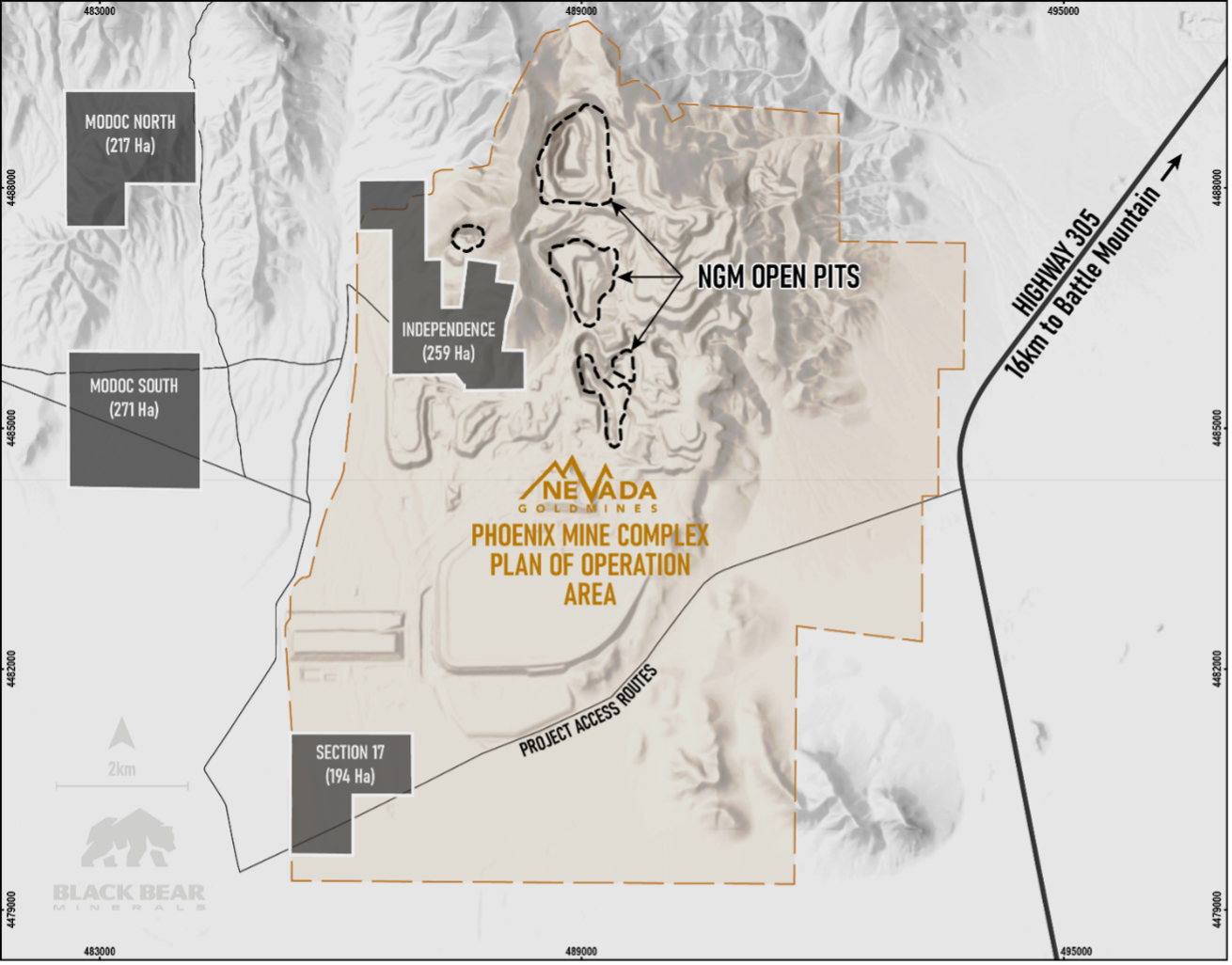
Figure 2: Independence Property overlayed with active Nevada Gold Mines (Newmont-Barrick JV) Phoenix Mine Complex, Plan of Operations
Geology & Mineralisation
The regional geology of north central Nevada is defined by episodic rifting, sedimentary deposition and erosion, followed by widespread thrusting. The Project encompasses a portion of the Antler orogenic zone that is host to the Golconda Allochthon that was emplaced during the Sonoma orogeny and contains the Mississippian-Permian Havallah Sequence, including the Pumpernickel Formation. The Pumpernickel Formation is host to epithermal near surface mineralisation at the Independence Project. Underlying the Golconda Allochton, the rocks of the Roberts Mountain Allochthon are the principal host of the Independence Skarn Mineralisation, as well as the neighbouring Phoenix Mine Complex mineralisation. To the west, the Modoc Claims encompass the upper chert, sandstone and siltstones of the Golconda Allochthon that are host to the Buffalo Valley Mine.
A series of Tertiary porphyritic granitoids have intruded along northeast-trending structures with a series of related dykes and stockworks present in the immediate vicinity surrounding the intrusions. These intrusions play an important role in the skarn and intrusion-related mineralisation across the Independence Project and Phoenix Mine Complex.
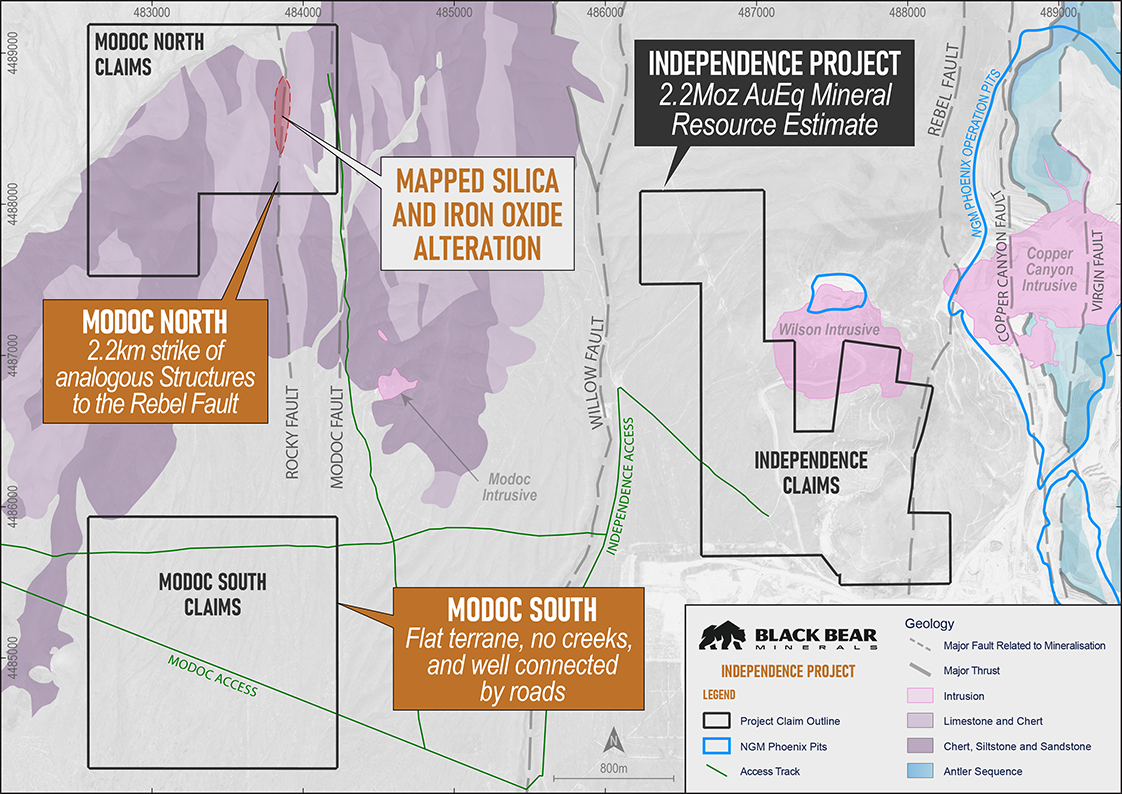
Figure 3: Independence and Modoc Claims in relation to key structures, intrusives and the Phoenix Mine Complex.
Mineralisation at the Independence Project comprises a near-surface high-level epithermal system formed as a leakage halo above a skarn system. The shallow oxide chert-hosted gold-silver epithermal mineralisation consists of iron oxides and clays derived from primary sulphide stockworks and replacements, deeply weathered and oxidised. The skarn mineralisation is a high-grade, gold-rich system primarily developed in the carbonate units of the Battle Formation in the lower portion of the Roberts Mountain Allochthon. Combined, the Independence Project comprises a combined 2.2Moz AuEq Mineral Resource Estimate, including a 1.0Moz Au high-grade skarn resource at 6.29g/t Au and a 1.2Moz AuEq from-surface epithermal resource."

Figure 4: Near surface pit-constrained mineral resource estimate with unclassified mineralisation below the pit. Skarn mineral resource wireframes displayed in relation to drillhole intercepts 580m along strike.
| Skarn Mineral Resource Estimate – May 2026 |
| Inferred |
3.2 |
4,958,400 |
6.29 |
1,002,500 |
| Total Contained Au Ounces |
1,002,500 |
|
| Epithermal Mineral Resource Estimate |
| Indicated |
26,641,200 |
0.44 |
0.40 |
7.5 |
376,300 |
345,300 |
6,452,200 |
| Inferred |
63,279,300 |
0.41 |
0.37 |
6.6 |
841,100 |
755,200 |
13,518,200 |
| Total Epithermal |
89,920,600 |
0.42 |
0.38 |
6.9 |
1,217,400 |
1,100,500 |
19,970,400 |
Gold equivalent values are based on a gold price of US$2,590.60/oz and silver price of US$30.50/oz, with gold recovery of 79% (oxide), 50% (transitional) and 22% (fresh), and silver recovery of 27% across all material.
The classification of the Mineral Resource Estimate is consistent with the JORC Code 2012. Mineral Resources which are not Mineral Reserves do not have demonstrated economic viability.
Table 1: JORC Resource Estimates
Skarn Mineral Resource
The 1.0Moz at 6.29g/t gold-only skarn resource is hosted in the calcareous conglomerate and carbonate sequences of the Battle Formation. The Battle Formation is the same stratigraphic unit that is host to Nevada Gold Mines’ Phoenix Mine Operation that produces 240koz Au per annum.
Recent test work by the Company has shown metallurgical recovery of skarn gold mineralisation to be up to 95.9% and has confirmed that gold is non-refractory and can be processed by conventional methods including gravity recovery followed by carbon-in-leach (CIL) circuit with low reagent consumption.

Figure 5: Near surface pit-constrained mineral resource estimate with unclassified mineralisation below the pit. Skarn mineral resource wireframes displayed in relation to Phoenix Mine Complex.
The skarn mineral resource estimate covers less than a third of the Independence Property and is open in all directions. Future drilling will focus on expansion of the skarn resource to the north.

Figure 6: High-grade skarn mineral resource estimate in relation to Phoenix Mine Complex. The northern half of the Project is largely not drill tested.
Near Surface Mineral Resource
The 1.2Moz AuEq at 0.42g/t gold-equivalent from-surface resource comprises epithermal gold-silver mineralisation hosted within the Pumpernickel Formation. The epithermal mineralisation is additionally dissected by porphyritic dykes and related breccias that represent targets for high-grade polymetallic mineralisation.
Historic drilling at the Project primarily focused on defining near-surface oxide mineralisation within the chert, with most drilling being undertaken to a predefined total depth. As such, a number of historic drill holes end in mineralisation, creating opportunities to extend and infill prospective areas beyond the current mineralisation model.
Recent drilling has targeted extensions outside the near-surface mineral resource, proving exceptional growth potential remains across the entire strike length of the Project.
A key focus of resource growth is the Rebel Trend, where rock chip sampling returned assay results up to 16.6g/t Au outside of the mineral resource, where the Rebel Fault and intrusions crosscut the main epithermal gold mineralisation trends.
Thick intercepts of gold mineralisation within the chert are amendable to heap-leach extraction. Heap-leach is a widely utilised method across Nevada’s epithermal deposits, including at Nevada Gold Mines Phoenix Mine Complex located directly adjacent to the Independence Project, and the nearby SSR-operated Marigold Complex that was operating between 0.13 – 0.36 g/t Au in 2024 (Figure 1).
Both the near-surface and skarn resources remain open in all directions, providing exceptional upside at the Project for resource growth beyond the combined 2026 Mineral Resource Estimate of 2.2Moz AuEq.
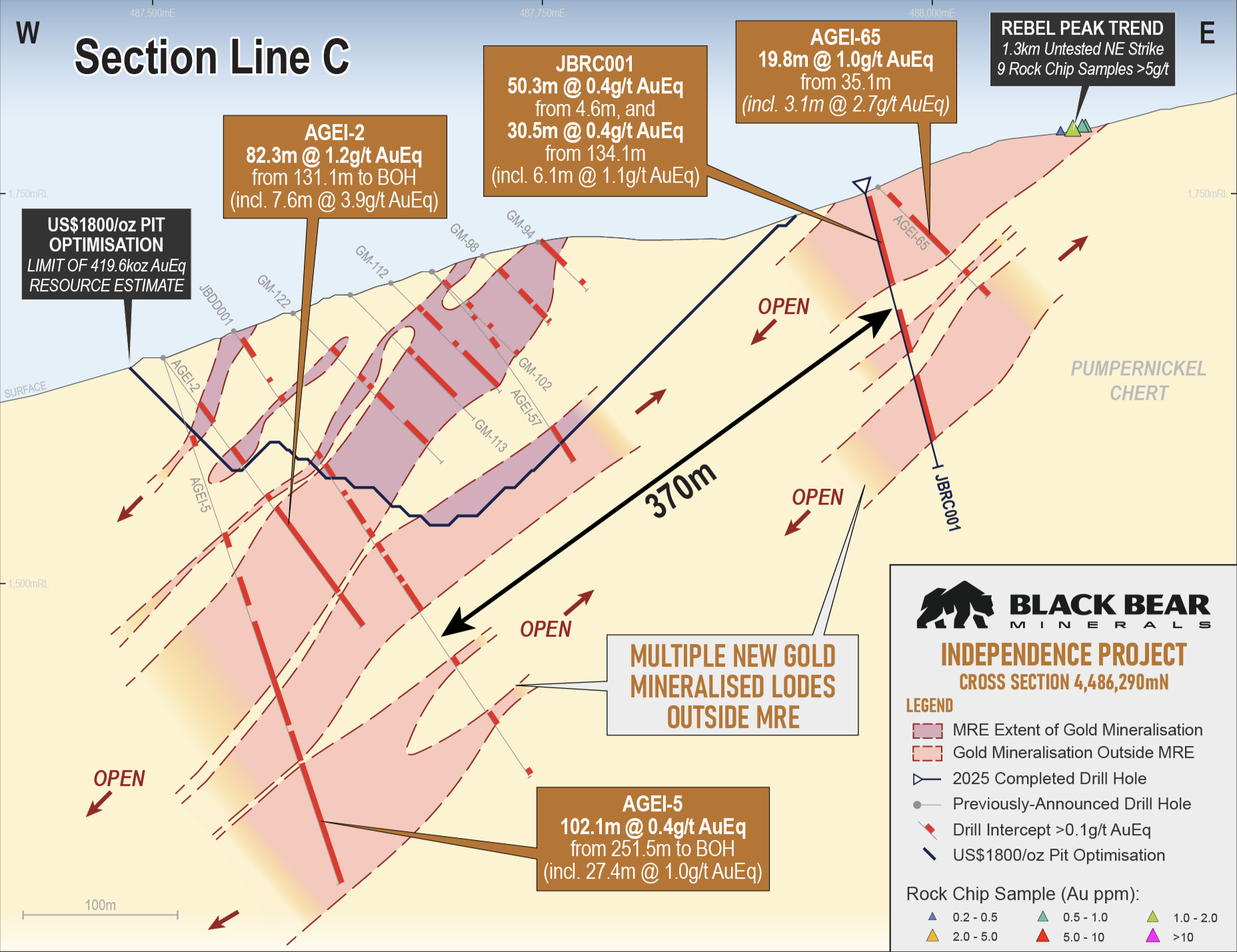
Figure 7: Cross Section through the Near-Surface Mineral Resource Estimate showing drill intercepts outside the pit-constrained Mineral Resource Estimate.
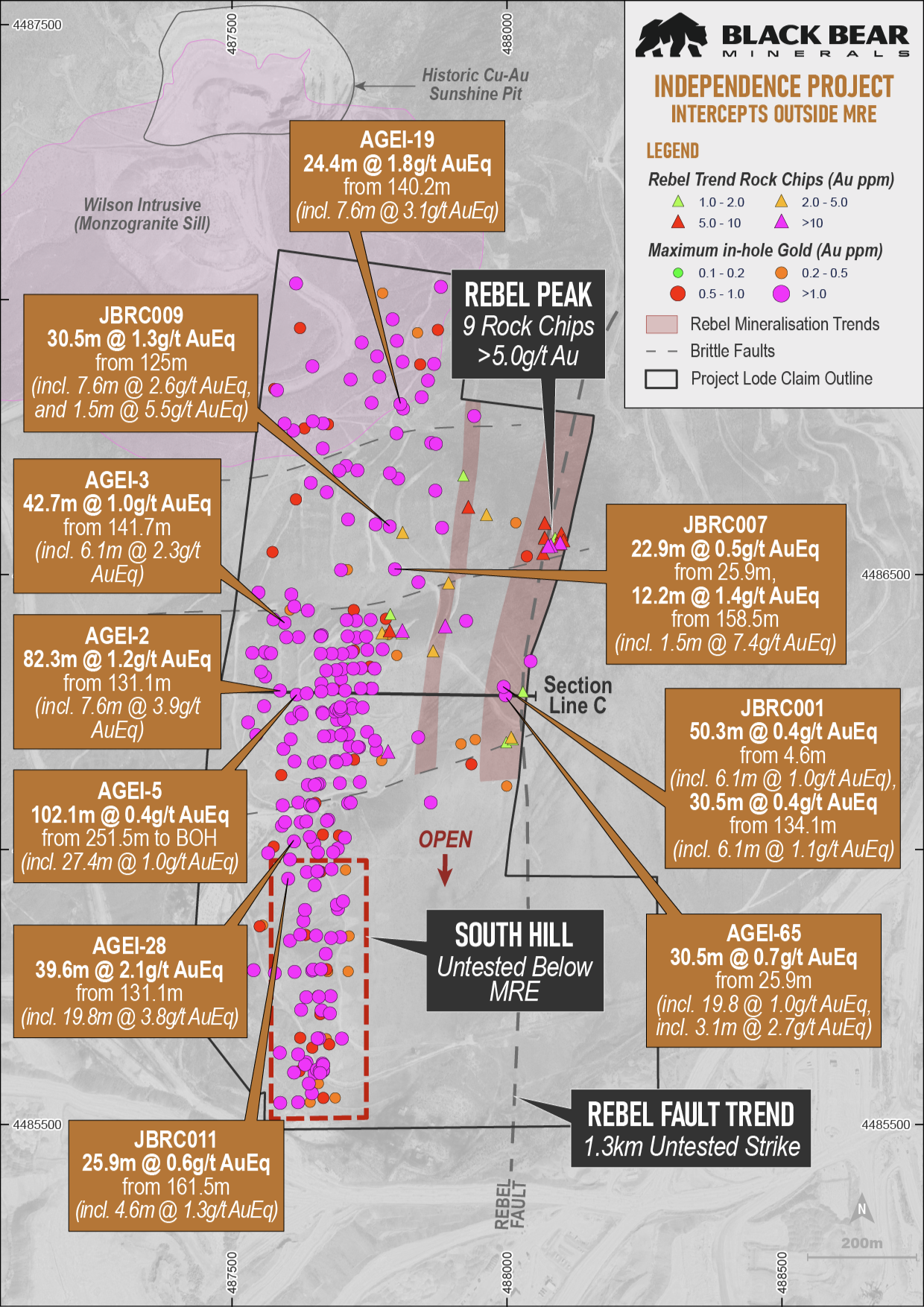
Figure 8: Drill hole intercepts outside the Near-Surface Mineral Resource Estimate. Rebel Trend surface rock chip samples and maximum in-hole gold displayed.
Next Steps
The updated 2026 Mineral Resource Estimate of 2.2Moz AuEq represents an increase of approximately 815,900oz since the 2025 maiden MRE, achieved at a low resource growth cost of A$4.71 per ounce following around 12 months of drilling.
Epithermal Resource Expansion
Further extension potential exists across multiple areas of the epithermal resource, including along the Rebel Trend to the east of the Project, down dip in the northern half, and below the drilled extents of the southern portion of the Project. The Rebel Trend is currently defined over 280m of strike with mineralisation open in both directions and at depth, with approximately 1km of strike remaining to be drill tested.
The southern portion of the epithermal MRE has not been drill tested by the Company, with all historic drilling conducted to shallow set depths. Drilling to test for additional stacked mineralised lodes below the southern half of the epithermal resource is planned.
Lower Pumpernickel Formation
Limited historic sampling has demonstrated significant mineralisation is present within the Lower Pumpernickel Formation, between the epithermal and skarn resources, including high-grade intercepts up to 7.6g/t Au. Further work is required to delineate mineralisation across this zone through core sampling and additional drill testing.
Skarn Resource Expansion
The skarn resource remains open for further expansion, particularly to the north, where historic drilling encountered similar skarn mineralisation approximately 580m outside the current resource area. Drill testing of this northern extension is planned. Additionally, drillhole WI-001 intersected high-grade mineralisation within the Harmony Formation at 8m @ 14.9g/t Au, not included in the current MRE, providing further scope for extensions beneath the current resource.
Metallurgical Testwork
Metallurgical testwork across all epithermal oxidation states (oxide, transitional and sulphide) is planned to optimise the processing flowsheet for gold and silver recovery. Historic testwork focused primarily on heap-leach amenability for oxide material only. A significant portion of the epithermal resource sits within transitional and sulphide classifications where recoveries are yet to be fully characterised.
The Company is advancing mining studies with a focus on a low-strip, heap-leach development pathway, leveraging the Project's location in Tier-1 Nevada.
Click through to see the Acquisition Announcement here
Forward-looking statements
This announcement may contain certain forward-looking statements, guidance, forecasts, estimates or projections in relation to future matters (Forward Statements) that involve risks and uncertainties, and which are provided as a general guide only. Forward Statements can generally be identified by the use of forward-looking words such as “anticipate”, “estimate”, “will”, “should”, “could”, “may”, “expects”, “plans”, “forecast”, “target” or similar expressions and include, but are not limited to, indications of, or guidance or outlook on, future earnings or financial position or performance of the Company. The Company can give no assurance that these expectations will prove to be correct. You are cautioned not to place undue reliance on any forward-looking statements. None of the Company, its directors, employees, agents or advisers represent or warrant that such Forward Statements will be achieved or prove to be correct or gives any warranty, express or implied, as to the accuracy, completeness, likelihood of achievement or reasonableness of any Forward Statement contained in this announcement. Actual results may differ materially from those anticipated in these forward-looking statements due to many important factors, risks and uncertainties. The Company does not undertake any obligation to release publicly any revisions to any “forward- looking statement” to reflect events or circumstances after the date of this announcement, except as may be required under applicable laws.
